
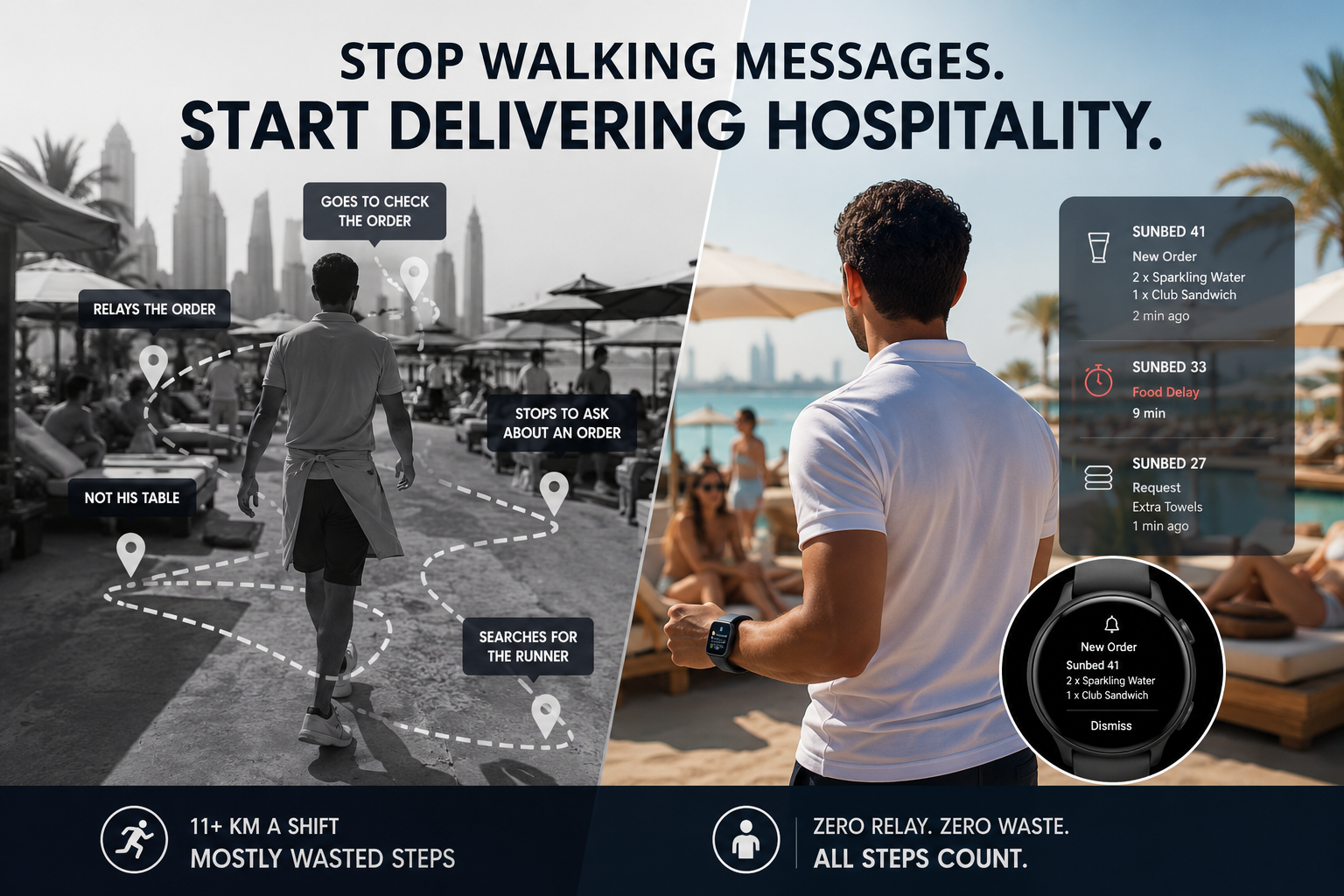
Stand at the service bar of any big beach club in Dubai around 2 PM in August and watch one waiter for twenty minutes. Don't watch what he carries. Watch where he goes.
He walks to sunbed 41 because the guest raised a hand. Walks back to relay the order. Walks out again to double-check whether she said sparkling or still, because the bar asked and he isn't sure. Walks the drink out. On the way back he's stopped by sunbed 33, who ordered from someone else twenty minutes ago and wants to know where their food is. He doesn't know. He walks to the kitchen to find out. It's not his order. He finds the runner. The runner also doesn't know.
Put a fitness tracker on that man and he'll clock eleven, twelve kilometers before sunset. Ask him at the end of the shift how much of it was service, the part guests remember, the part they tip for, the part he's actually good at and he'll tell you: maybe a quarter. The rest was transport. Not of food. Of information.
You've read the numbers, or you're living them. The sector is running an estimated 18% below the staffing it needs this year. In AHLA's surveys, 65% of hotels report shortages and 71% have roles they cannot fill no matter what they pay. The WTTC says the industry needs 460 million more workers globally within a decade and has no idea where they're coming from. In the Gulf, where new properties open monthly and recruit from the same exhausted pool, every operator knows the feeling of being outbid for a captain by the resort next door.
So the reflex is: hire more, pay more, poach back. And fine, do those things. But there's a question almost nobody asks first, and it's worth more than any signing bonus:
How many of the person-hours you already pay for are spent moving messages instead of serving people?
Because that waiter doing laps isn't understaffed. He's mis-deployed. His employer is paying premium wages for a courier service between the guest's mouth and the kitchen's ear, a job that stopped requiring legs the day requests could travel as data.
Same beach. Same headcount. One change: the guest at sunbed 41 taps her order on her phone, and it lands, with the sunbed number attached, on the wrist of whoever covers beds 35 through 50. No relay. No sparkling-or-still return trip; it's written down because she wrote it. Sunbed 33's missing food isn't a mystery anyone has to solve on foot; it's an open ticket with a timestamp and an owner, visible to the supervisor, who can see it's been sitting for nine minutes and fix it before the guest asks anyone.
The waiter still walks, hospitality happens on foot, but now nearly every trip ends at a guest with something in hand. His radius of coverage doubles. Nothing gets lost in relay, because there is no relay. And the maddening, tip-killing conversations: I'll check for you, I'm not sure who took that, let me find someone, mostly stop happening, because the system knows what he used to have to go find out.
Run that across a season and the arithmetic gets loud. If a third of a fourteen-person floor team's hours were coordination overhead, you've just recovered the output of four or five staff you were never going to be able to hire anyway. Not by asking anyone to move faster. By deleting the kilometers that never served a guest.
There's a second dividend, and it shows up in your turnover number, which, in this industry, runs as high as 70% a year in some markets.
Nobody quits hospitality because carrying a tray is hard. They quit because the job feels like chaos: getting shouted at for a delay that happened two handoffs upstream, being the face of failures they didn't cause and couldn't see. Give the same person a shift where every request they're responsible for is visible, timestamped, and theirs, and where their four-minute average delivery time across the busiest zone is on record, not just in one manager's impression, and the job changes shape. It becomes learnable in days instead of months, and excellence at it becomes provable.
The shortage is real. It's structural, it's global, and it is not getting better by 2030. Which is exactly why the operators who come out ahead won't be the ones who won the bidding war for staff. They'll be the ones who stopped spending their scarcest resource, trained human attention, on being the property's postal service.
Count the kilometers. Then ask what they bought you.
Ring N Bring routes guest requests straight to staff smartwatches, with the location attached, so teams spend their steps on service, not relay.