The review goes up at 9:47 PM:
★☆☆☆☆ — "Beautiful property, shocking service. Waited 40 minutes for a drink at the pool, had to get it myself in the end. Staff seemed lost. Won't be back."
The duty manager reads it three days later, when the weekly report flags the score dip. He asks around. Nobody remembers the guest. Nobody remembers the order. There is nothing to remember, the order was spoken to a waiter mid-rush, held in his head for ninety seconds, and displaced by the next three requests. It never existed anywhere except in the guest's rising irritation.
So let's do what the property can't, and reconstruct the afternoon.
3:41 PM — Guest orders a frozen lemonade from a passing waiter. He nods, genuinely intends to place it, and is intercepted twice before he reaches the bar. The order dies here. Nobody knows it yet, including him.
3:58 PM — Guest flags a second staff member. "Let me check on that for you." There is nothing to check. There is no ticket, no record, no it. She asks the first waiter, who half-remembers, and reorders. The clock, as far as the guest is concerned, has been running for seventeen minutes. As far as the bar is concerned, it just started.
4:12 PM — The drink is made and sits in the pass. The runner doesn't know which sunbed it belongs to, because "the lady by the pool" is not an address.
4:19 PM — The guest walks to the bar, orders directly, pays, and says nothing. This is the moment most operators misread. They think silence means the problem passed. Silence means the guest has stopped giving you chances. The complaint hasn't been dropped; it's been rescheduled, for a platform where you don't get a reply before the verdict.
9:47 PM — Verdict.
Nothing in that timeline is a catastrophe. A distracted waiter, a missing sunbed number, a drink orphaned in the pass: every property on earth has those moments daily. What turned three small failures into a permanent public record was that for 38 minutes, nobody with the power to fix the problem knew it existed.
The guest knew at 3:55. The property found out on Thursday.
That gap is now one of the most expensive intervals in hospitality. The global Guest Review Index hit 86.7% last year, an all-time high, which means the bar keeps rising and a service complaint stands out more, not less. Google alone carries close to half of review volume in some regions, sitting directly in the booking path. And the 2026 benchmark data shows service scores tracking one thing above all: operational consistency.
Guests don't review your brand promise. They review whether the lemonade showed up.
Service-recovery research has said the same thing for forty years: fix a problem while the guest is still in the chair and you often end up with a more loyal guest than if nothing had gone wrong. The catch is the shelf life. Recovery is priceless at minute five and worthless at day three. Which means the entire game is finding out at minute five.
Same afternoon. Same guest. Same team.
One structural difference: every request exists the moment it's is made.
3:41 PM — The guest places her order from her sunbed. It arrives instantly on the smartwatch of the waiter responsible for that zone, complete with the sunbed number. He accepts the request, and the guest immediately knows it's been received and is being prepared. No guessing. No wondering whether anyone heard her.
3:46 PM — The estimated delivery time is approaching. If the order hasn't been completed, the system doesn't wait for the guest to complain. It escalates automatically. The supervisor now sees an open request that's taking longer than expected and can step in before it becomes a problem.
The point isn't that nobody ever gets busy. They do.
The point is that no request disappears simply because someone got interrupted.
Now let's assume something still goes wrong. The blender breaks. The kitchen gets slammed. The order is genuinely delayed.
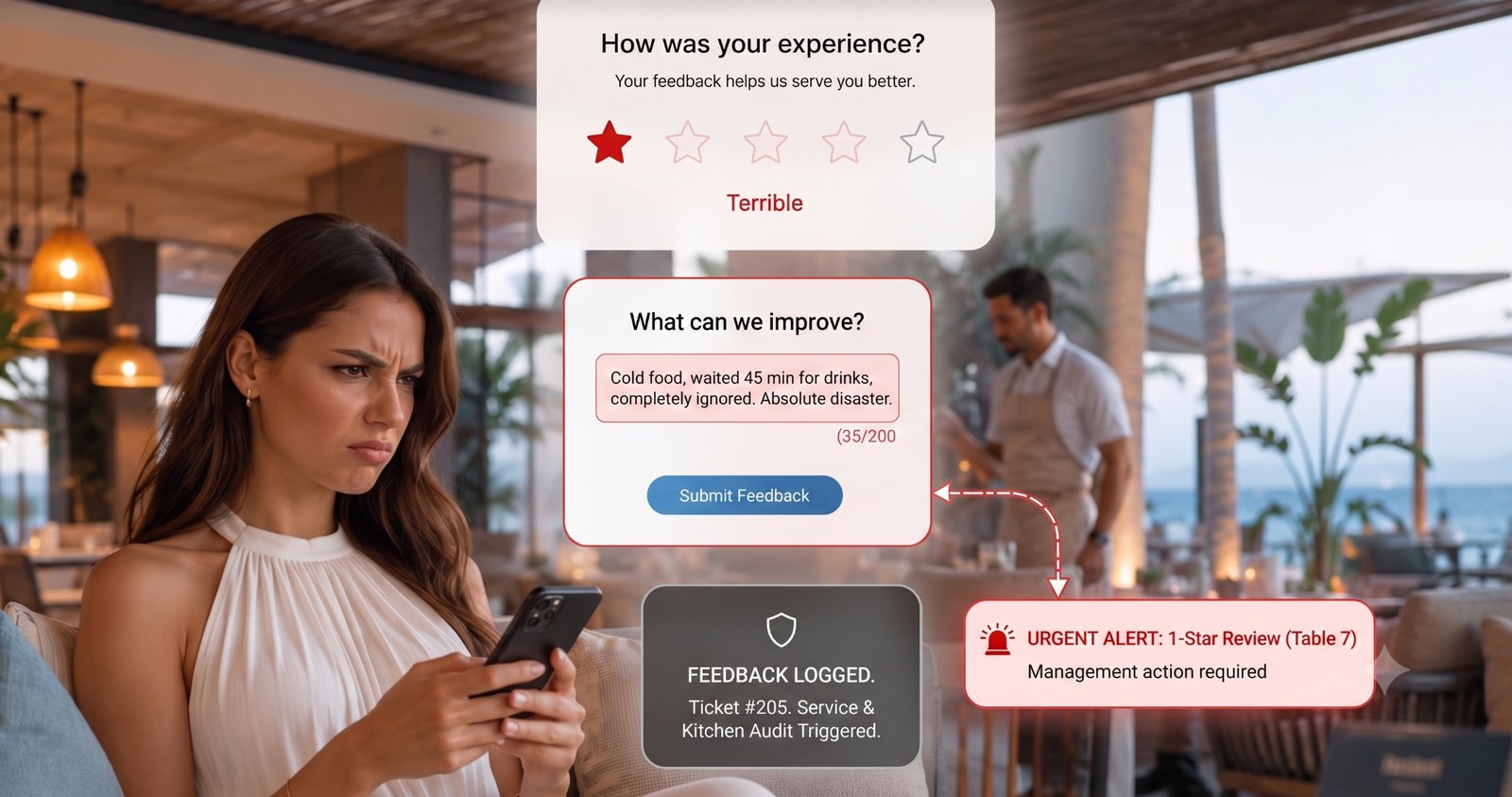
At 3:52 PM, instead of opening Google, the guest can easily submit the feedback through Ring n' Bring.
That alert doesn't disappear into a feedback inbox someone reads on Thursday. It reaches the duty manager while the guest is still sitting on the sunbed. They have a chance to apologize, explain, send a complimentary drink, or simply show the guest that someone noticed.
Because operational problems are inevitable.
Surprises aren't.
A one-star review doesn't always mean your operation failed. Sometimes it means your recovery failed.
The best operators don't eliminate every mistake. They eliminate the gap between the mistake happening and someone being able to fix it.
A complimentary dessert at 4:00 PM costs a few dollars.
The same sentence posted on Google at 9:47 PM can influence hundreds of future bookings.
The properties winning the review economy aren't the ones writing better responses to one-star reviews.
They're the ones preventing most of those reviews from ever being written.
Ring n' Bring ensures every guest request is acknowledged, tracked, and automatically escalated when it needs attention, giving operators the opportunity to recover the experience before it becomes a public review.